THE SHORT ANSWER
RG174 and RG316 are small coaxial cable families often compared for RF leads. Compare specific manufacturer part numbers: dielectric, jacket, temperature rating, attenuation and dimensions can affect the choice. Neither name alone guarantees the right loss or installation performance.
RG174 vs RG316 is a useful comparison when selecting a compact RF jumper, antenna lead or coaxial bulk cable for assembly. Buyers often want to know which cable has lower loss, which suits a warmer environment and whether one can replace the other without changing connectors.
The answer starts with the actual cable datasheet. The examples below use two named Belden parts to show how to compare specifications. They are reference examples, not ANNXIN product specifications or a claim that ANNXIN supplies those branded parts.
1. RG174 vs RG316: compare the construction first
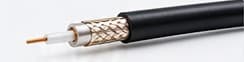
Belden 8216 is an RG174 example with polyethylene insulation and a PVC jacket. Belden 83284 is an RG316 example with PTFE insulation and an FEP jacket. The two examples also differ in shield material, nominal diameter and published operating temperature.
Those differences help explain why a cable replacement should be reviewed by part number. A similar outside diameter does not establish identical strip dimensions, termination compatibility or environmental suitability.
| Property | RG174 example: 8216 | RG316 example: 83284 |
|---|---|---|
| Nominal impedance | 50 Ω | 50 Ω |
| Insulation / jacket | PE / PVC | PTFE / FEP |
| Nominal cable diameter | 2.79 mm | 2.5 mm |
| Published operating temperature | −30°C to +75°C | −70°C to +200°C |
Technical reference: Belden 8216 construction and specifications ↗ · Belden 83284 construction and specifications ↗
2. Which cable has lower signal loss?
Compare attenuation at the same frequency and in the same length units. At 1 GHz, Belden publishes nominal attenuation of 34 dB/100 ft for 8216 and 29 dB/100 ft for 83284. In this specific comparison, the RG316 example has lower nominal cable attenuation. That result should not be generalized to every supplier’s RG174 and RG316 products.
As a calculation example, a 1 m length gives approximately 1.12 dB and 0.95 dB respectively, using 100 ft = 30.48 m. These are estimates from the published nominal cable values; they exclude connector transitions, assembly variation and any additional system losses.
For your RFQ, provide the operating band and an allowable finished-assembly loss. Ask for proposed cable data at that band and agree how the completed assembly will be verified. A comparison at 1 GHz does not establish performance at every other frequency.
Technical reference: Belden 8216 attenuation table ↗ · Belden 83284 attenuation table ↗
3. When should you consider a low-loss coaxial cable?
If neither candidate meets the loss budget at the required length, widen the comparison to a suitable low-loss coaxial cable. Start with a measurable requirement: maximum loss at a stated frequency over the planned cable route. The phrase low loss is not a complete specification.
Times Microwave’s loss calculator uses frequency, run length and cable selection as inputs. Apply the same discipline to your sourcing brief: compare the proposed constructions at the same band and distance, then review diameter, bend radius and connector fit alongside the electrical result.
For example, an enclosure lead may be limited by routing space, while an antenna feeder may be limited by the loss allowance over a longer run. Ask the supplier to explain the tradeoff for your installation instead of choosing a thicker or more expensive cable without a defined target.
Technical reference: Times Microwave cable loss calculator ↗
4. Check connector termination and mechanical fit
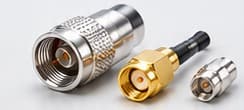
An RF connector must be intended for the selected cable construction. Check the manufacturer’s cable compatibility, strip preparation, ferrule dimensions and assembly method. A connector listed for one RG174 product should not automatically be reused with a different cable without review.
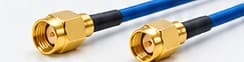
For an SMA to SMA cable assembly, the interface name identifies the mating end; it does not identify the cable termination geometry. When changing the cable, ask for an updated assembly drawing and review the sample in the actual routing space.
Also check whether the cable will be installed once or moved repeatedly. Record the intended motion and bend constraints in the specification. Avoid assuming that a small diameter means a cable is qualified for continuous flexing.
5. Buying coaxial bulk cable: an RFQ checklist
Bulk cable procurement adds requirements that are easy to miss when comparing finished jumpers. Tell the supplier how the cable will be cut, terminated, stored and inspected. If a named manufacturer part is required, state whether alternatives are acceptable and how they will be approved.
Use a controlled datasheet and part number for repeat purchases. Ask for clear traceability and the documentation needed by your organization rather than assuming that an RG designation establishes certification or brand origin.
- Cable type and manufacturer part number, or a documented set of requirements.
- Operating band, impedance, attenuation limit and temperature conditions.
- Outer diameter, bend constraints and intended connector terminations.
- Required total length, reel or cut-length arrangement, labeling and packaging.
- Quantity, destination, requested documentation and acceptance process.
6. Make the decision around the requirement
Consider an RG174 candidate when its actual datasheet meets the electrical, temperature and routing requirements. Consider an RG316 candidate when its documented construction and ratings better match the job. Assess a different low-loss coaxial cable when neither option meets the loss allowance at your installed length.
ANNXIN supports inquiries for coaxial bulk cable and RF cable assemblies. Send your cable specification, planned length, connector requirements and quantity for review. Exact construction, available documentation, pricing and delivery are confirmed for the quoted product.
QUICK ANSWERS
Frequently asked questions
Is RG316 always better than RG174?
No. Compare the actual cable part numbers against your loss budget, temperature, mechanical requirements and cost target. A higher rating in one property does not make a cable the best choice for every installation.
Are RG174 and RG316 both 50 ohm coaxial cables?
The Belden 8216 and 83284 reference examples in this guide are both nominally 50 Ω. Confirm the impedance and all other ratings on the specific proposed cable datasheet.
Can RG316 replace RG174 in an SMA cable assembly?
Only after reviewing the connector termination, cable dimensions, routing and finished-assembly requirements. Update the drawing and approve the proposed substitution rather than assuming the interface name establishes compatibility.
Does a low-loss coaxial cable need a specified frequency?
Yes. State the operating band, length and allowable loss. Ask the supplier for data at the relevant frequencies and distinguish cable attenuation from completed-assembly performance.
RELATED PRODUCTS
Explore ANNXIN coaxial bulk cable and RF productsConfirm specifications and availability for your particular configuration.
Ready to specify your connection?
Share your operating band, cable length, loss target and quantity to discuss coaxial bulk cable or a finished assembly.
Request a configuration review →