THE SHORT ANSWER
Choose an RF cable assembly by specifying both mating interfaces, cable construction, finished length and operating requirements. Approve the complete assembly drawing and acceptance criteria before ordering; a connector name alone does not define performance.
Searching for a custom RF cable assembly usually starts with a connection problem: two equipment ports do not match, an antenna needs to reach an enclosure wall, or a standard cable length will not fit. The useful question is which complete assembly fits your electrical requirements, installation and purchasing process.
This guide helps equipment buyers, distributors and OEM teams prepare a clear RF coaxial cable assembly specification. It covers SMA to SMA cable assemblies, SMA to IPEX antenna pigtails and the details that make quotations easier to compare.
1. Identify connector A and connector B
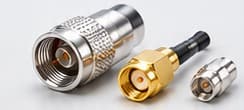
Write down the interface at each end separately. Include connector family, plug or jack, standard or reverse polarity, and straight or right-angle orientation. If the connector mounts through an enclosure, add the bulkhead dimensions, panel thickness and hardware requirements.
For an SMA connection, inspect the center contact as well as the threaded body. For a miniature board connection, use the equipment manufacturer’s receptacle part number. A photo is helpful, but the mating drawing should settle any uncertainty before the assembly is approved.
- Connector A: family, gender, polarity, orientation and mounting.
- Connector B: the same information, checked independently.
- Attach the equipment interface drawing or a clear face-on photo.
2. SMA to SMA or SMA to IPEX: which configuration fits?
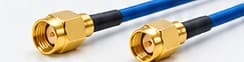
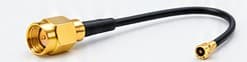
An SMA to SMA cable assembly connects equipment that already uses SMA interfaces. An SMA to IPEX cable is often requested as an antenna pigtail between a small board-mounted RF connector and an external connection. These descriptions identify a starting configuration, not a complete order specification.
IPEX is commonly used as a search term, but I-PEX offers several MHF series. Its MHF I and MHF 4 product pages describe different interfaces and mating heights. Record the exact series and part number; do not treat every miniature connector advertised as IPEX or U.FL as interchangeable.
| Requested assembly | Typical connection task | Confirm before quotation |
|---|---|---|
| SMA to SMA cable assembly | An RF jumper between SMA-equipped devices | Both ends’ gender and polarity; cable and length |
| SMA to IPEX cable / antenna pigtail | A board RF port to an enclosure connection | Exact microconnector series and mating receptacle |
| Low-loss RF cable assembly | A connection with a defined loss budget | Frequency, run length and maximum assembly loss |
Technical reference: I-PEX MHF I product information ↗ · I-PEX MHF 4 product information ↗
3. Choose the coaxial cable around the installation
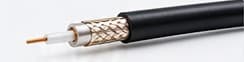
Give the supplier your operating frequency range, system impedance, allowable insertion loss and available routing space. Ask which cable constructions meet those requirements at the finished length. If RG174 or RG316 is under consideration, compare the actual proposed cable datasheets rather than choosing by the RG name alone.
Include the minimum bend radius, installation temperature, expected movement and exposure to moisture or sunlight. A short internal antenna lead and a longer outdoor feeder have different mechanical constraints. Specify those conditions in the RFQ so a low-loss coaxial cable is assessed alongside its diameter, flexibility and termination options.
Separate cable-level data from assembly-level requirements. Connector transitions and the finished build must be considered when agreeing the assembly specification. Ask for the test method and acceptance limits needed by your application instead of assuming that every cable receives the same RF tests.
4. Specify finished length and drawing details
State the length measurement reference: mating plane to mating plane, end to end, or another clearly drawn datum. Add a tolerance and define any relative orientation between right-angle connectors. This avoids receiving a cable that matches a nominal number but does not route correctly.
For OEM RF cable assemblies, place the connector codes, cable part number, length, labels and drawing revision in one controlled document. Review a sample in the actual enclosure when routing or access is tight. Record any agreed changes in the drawing before ordering the production quantity.
5. Send an RFQ suppliers can quote consistently
A useful quotation request connects the engineering requirement to the purchasing requirement. Provide the intended quantity, sample quantity, destination and required delivery schedule. Ask suppliers to identify any proposed substitutions so different quotations remain comparable.
Use the brief below as a starting point. Replace every placeholder with your project data; it is an example inquiry format, not a statement of available stock or guaranteed performance.
- Product: custom RF coaxial cable assembly; connector A and connector B with full part references.
- Cable: requested type or part number; finished length, tolerance and drawing reference.
- Electrical: operating band, impedance, loss limits and required test documentation.
- Mechanical: routing, bend constraints, mounting and environment.
- Commercial: sample quantity, production quantity, destination, packaging and schedule.
6. Review the complete configuration with ANNXIN
ANNXIN provides RF cable assemblies, coaxial bulk cable and RF connectors with OEM/ODM support. Start with your drawing or a configuration brief, then confirm the proposed build, documentation, sample needs and commercial terms with the team.
If both equipment interfaces are SMA, use the SMA to SMA product page as a configuration starting point. For an SMA to IPEX request, include the board receptacle reference. For a longer run, state the loss budget so the cable discussion starts with the application requirement.
QUICK ANSWERS
Frequently asked questions
What information is needed for a custom RF cable assembly quote?
Provide both connector interfaces, cable type or requirements, finished length and tolerance, operating frequency, quantity and destination. Include drawings and any inspection or test requirements.
Is an SMA to IPEX cable the same as an SMA to U.FL cable?
Do not assume so from the sales description. I-PEX and Hirose have multiple miniature RF connector families. Confirm the exact plug and mating receptacle part numbers and their documented compatibility.
Can I choose an RF cable only by its frequency rating?
No. Check the complete assembly’s agreed performance, finished length, connector compatibility and installation conditions as well as the frequency range.
Can ANNXIN review a custom cable length?
Share the requested length, measurement reference and configuration. ANNXIN can review the requirement; feasibility, tolerance, price and lead time are confirmed for the specific quotation.
RELATED PRODUCTS
Explore the SMA to SMA cable configurationConfirm specifications and availability for your particular configuration.
Ready to specify your connection?
Send your connector A/B, cable type, length and quantity. Let’s review your RF cable assembly configuration.
Request a configuration review →